Poster Number #1, Abstract #10306
Brian J. Weir1,2, Aaron J. Robbins1, & Elizabeth J. Walsh1
- Department of Biological Sciences, University of Texas at El Paso
- School of Earth, Environment, & Society, Portland State University

These web-based resources and materials are intended to make information accessible for poster viewers to self-serve when an author is not present. As an undergraduate on an academia track, I am interested in finding ways to increase science communication using easy to administer technology tools. This is designed to be used on a mobile device while in front of the poster; other devices may display titles strangely. Feel free to share feedback, as it is very welcome. You will find data and information that is not included in the poster, but is referenced either in the text or planned to be brought up in the poster presentation.
-Brian John Weir (contact details available below)
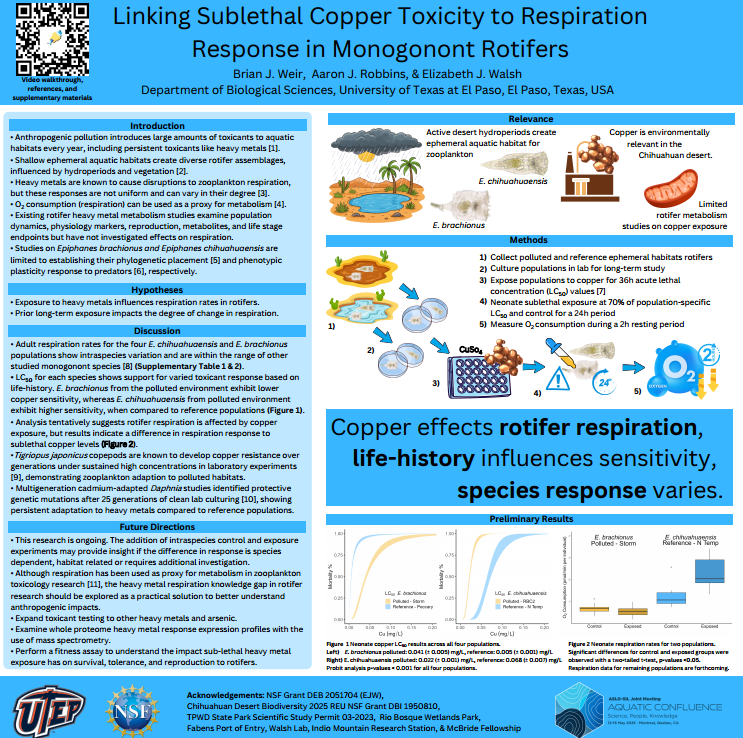
Access a copy of the poster by clicking on the picture below
Click on a link below to access the resources on this page
Abstract
Anthropogenic metal contamination challenges freshwater ecosystems, and trace concentrations can impair physiological functions of organisms. Rotifers are valuable models for assessing heavy metal toxicity in aquatic habitats. We evaluated whether long-term habitat history influences tolerance to copper sulfate exposure by comparing two populations each of Epiphanes brachionus and E. chihuahuaensis, isolated from polluted and non-polluted temporary environments. Acute toxicity tests were used to determine lethal concentrations (LC50) of 0.041 mg/L for E. brachionus and 0.068 mg/L for E. chihuahuaensis, both below the mean for monogonont rotifers (~0.096 mg/L). To determine sublethal effects, rotifers were exposed to 70% of the LC50 for 24 h, followed by a 2 h recovery period, during which oxygen consumption was measured. Control respiration rates for neonates averaged 0.68 and 1.2 pmol oxygen/min/ind for E. brachionus and E. chihuahuaensis, respectively; adult rates were ~ 4 times higher. Following copper exposure, neonate E. brachionus from a polluted habitat exhibited a 20.6% decrease in respiration relative to controls, whereas E. chihuahuaensis from a non-polluted habitat showed an 82.4% increase. These preliminary findings show lineage- and history-specific metabolic effects of long-term exposure to pollutants. This study links mortality thresholds and physiological endpoints such as respiration within historical exposure context in ephemeral pools, advancing our understanding of toxicant stress response and reiterates the value of rotifers as bioindicators.
Video Walkthrough of Poster Sections
Introduction & Relevance
Methods & Hypotheses
Results & Discussion
Figures and Tables
Table 1. Adult and available neonate mean respiration rates for the study populations
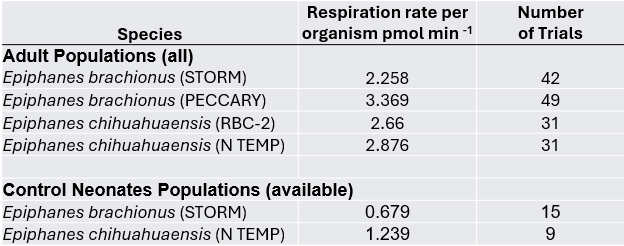
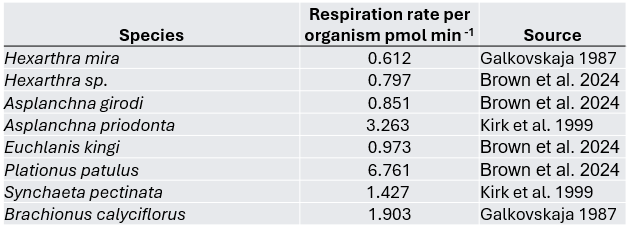
Table 2. Adult monogonont rotifer respiration rates from other studies [7]
LC50 Graphs
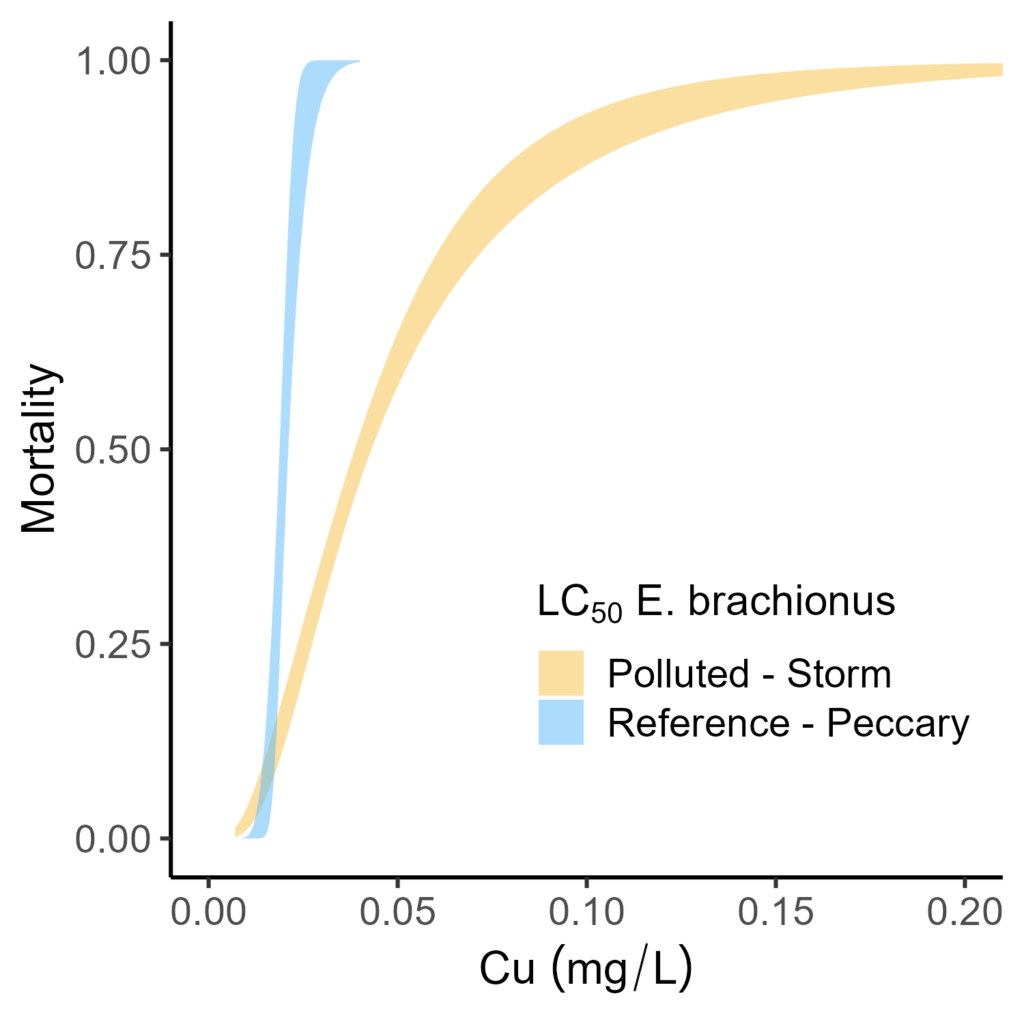
Figure 1A Neonate copper LC50 results E. brachionus polluted: 0.041 (± 0.005) mg/L (n=330), reference: 0.005 (± 0.001) mg/L (n=506)
Probit analysis p-values < 0.001
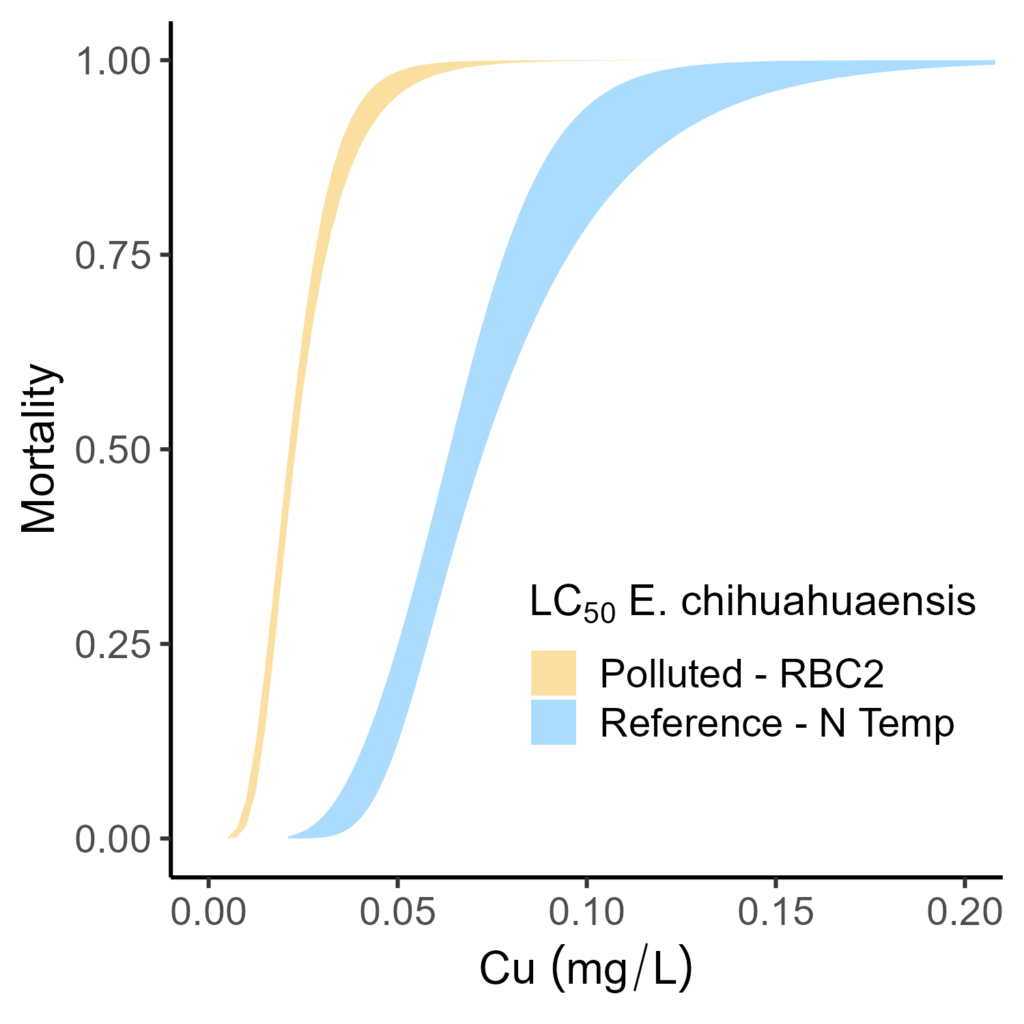
Figure 2A Neonate copper LC50 results E. chihuahuaensis polluted: 0.022 (± 0.001) mg/L (n=301), reference: 0.068 (± 0.007) mg/L (n=79)
Probit analysis p-values < 0.001
Respiration Box Plots
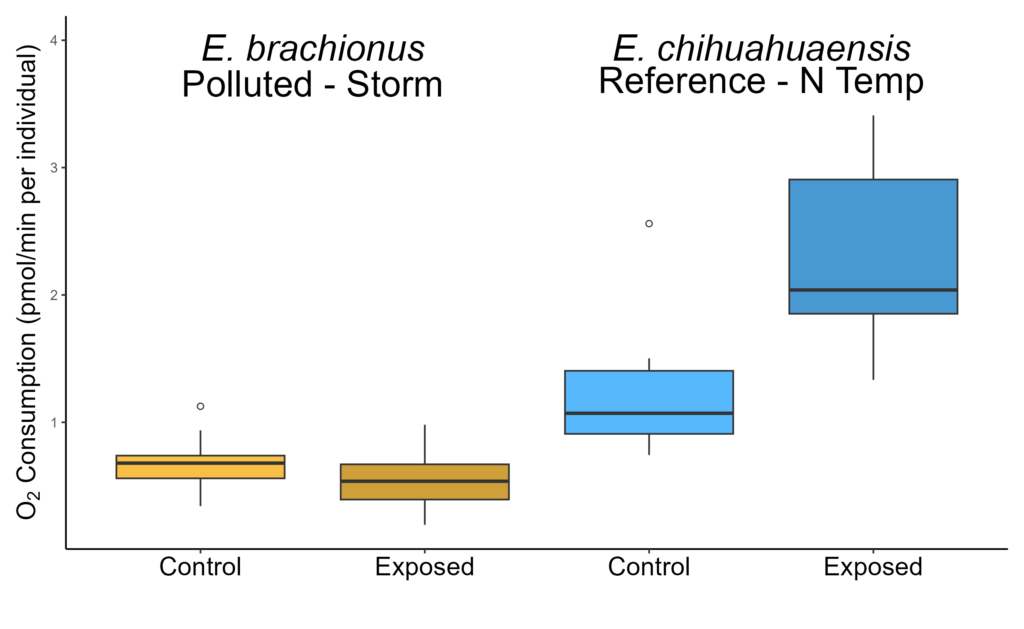
Figure 2 Neonate respiration rates for two populations. Significant differences for control and exposed groups were observed with a two-tailed t-test, p-values <0.05. Sample sizes of trials: n=37, n=16, n=13, n=9 (respectively left to right)
Respiration data for remaining populations are forthcoming.
Contact Details
Brian J. Weir
Email:
bweir@pdx.edu
Linked In:
https://www.linkedin.com/in/brian-weir-71500613/
2025 Summer REU Student
Department of Biological Sciences
The University of Texas at El Paso
El Paso, Texas, 79968
United States of America
Undergraduate Student
Department of Environmental Science
and Management
Portland State University
Portland, Oregon 97203
Unites States of America
Aaron J. Robbins
Email:
ajrobbins@miners.utep.edu
Linked In:
https://www.linkedin.com/in/aaron-robbins-63645a127/
PhD Candidate
Department of Biological Sciences
The University of Texas at El Paso
El Paso, Texas, 79968
United States of America
Elizabeth J. Walsh
Email:
ewalsh@utep.edu
Linked In:
https://www.linkedin.com/in/elizabeth-walsh-324ab568/
Department of Biological Sciences
The University of Texas at El Paso
El Paso, Texas, 79968
United States of America
References
1. Donat-P. Häder, Anastazia T. Banaszak, Virginia E. Villafañe, Maite A. Narvarte, Raúl A. González, E. Walter Helbling (2020). Anthropogenic pollution of aquatic ecosystems: Emerging problems with global implications, Science of The Total Environment, Volume 713, 2020, 136586, ISSN 0048-9697. https://doi.org/10.1016/j.scitotenv.2020.136586.
2. Brown, P. D., Schröder, T., Ríos-Arana, J. V., Rico-Martínez, R., & Silva-Briano, M. (2022). Processes contributing to rotifer community assembly in shallow temporary aridland waters. Hydrobiologia, 849(17-18), 3719-3735. https://doi.org/10.1007/s10750-022-04842-8
3. Amer, Amany S. (2024). Assessment of Difference Between Heavy Metals Concentrations in Water and Zooplankton” Egyptian Journal of Aquatic Biology and Fisheries 28.1: 1335-1350.
4. Mohl, J., Brown, P.D., Robbins, A, Lavretsky, P., Hochberg, R., Wallace, R., Walsh, E. (2025). Comparing Small and Large Genomes Within Monogonont Rotifers, Genome Biology and Evolution, Volume 17, Issue 3, March 2025, evaf041, https://doi.org/10.1093/gbe/evaf041
5. Gilbert, J. J. (2023). Epiphanes brachionus spinosa from a temporary habitat in the Chihuahuan Desert: Morphological response to Asplanchna and control of sexual reproduction. Freshwater Biology, 68, 2175–2183. https://doi.org/10.1111/fwb.14185
6. SCHRÖDER, T. and WALSH, E.J. (2010), Genetic differentiation, behavioural reproductive isolation and mixis cues in three sibling species of Monogonont rotifers. Freshwater Biology, 55: 2570-2584. https://doi.org/10.1111/j.1365-2427.2010.02487.x
7. Martinez-Gomez et al. (2015). Lethal and sublethal effects of selected PPCPs on the freshwater rotifer, Plationus patulus, Environmental Toxicology and Chemistry, Volume 34, Issue 4, 1 April 2015, Pages 913–922, https://doi.org/10.1002/etc.2873
8. Brown, P. D., & Walsh, E. J. (2024). Scaling of respiration in colonial invertebrates. Limnology and Oceanography, 69(8), 1746-1756.
9. Kwok, K. W. H., Grist, E. P. M., & Leung, K. M. Y. (2009). Acclimation effect and fitness cost of copper resistance in the marine copepod Tigriopus japonicus. Ecotoxicology and Environmental Safety, 72(2), 358–364 https://doi.org/10.1016/j.ecoenv.2008.03.014.
10. Keith, N. et al. (2026). Discovery and Evaluation of Cadmium-Adapted Daphnia pulex Genotypes in a Region of Historical Mining Reveals Adaptation Protects the Germline from Cadmium-Induced Mutations. Molecular Ecology.
11. Wollenberger, L., Halling-Sørensen, B., & Kusk, K. O. (2000). Effects of toxicants on zooplankton metabolism: Using oxygen consumption to infer metabolic disturbances. Ecotoxicology and Environmental Safety, 46(3), 236-243.
Graphical References:
12. Perplexity Generative AI was used to debug and polish R Studio code for LC50 and Respiration Boxplot display.
13. Graphics are a part of the licensed Canva suite of available graphics. Canva generative AI was used to alter one piece of clip art to change the color of the pool to brown.
14. Rotifer, copepod, daphnia, protein, DNA are free icons provided by Flaticon suite.
15. QR code was generated by Microsoft Word embed code generator.
16. R Code was polished and debugged with Perplexity AI
Open Data (GitHub)
Access all of our data including R Code and raw data is available for you to re-run our statistical analysis and provide feedback on our findings. Please feel free to run that data, but respect the privacy of ongoing research and do not publish any results.
You can find the following details at our GitHub site https://github.com/Brian-weir-pdx/LinkingRotiferRespiration
To protect the unpublished data, please reach out to bwier@pdx.edu to request password access these files with a reason for your request.
- R Studio code for the LC50 Charts, Probit analysis, and box plots
- LC50 raw data from experimental trials
- Micro respirometry data from Loligo equipment for populations displayed on poster
- References and more